FINANCING INSTRUMENTS

€20+ billion in business opportunities. Find, combine and use financial instruments that match your business goals.

decor_image

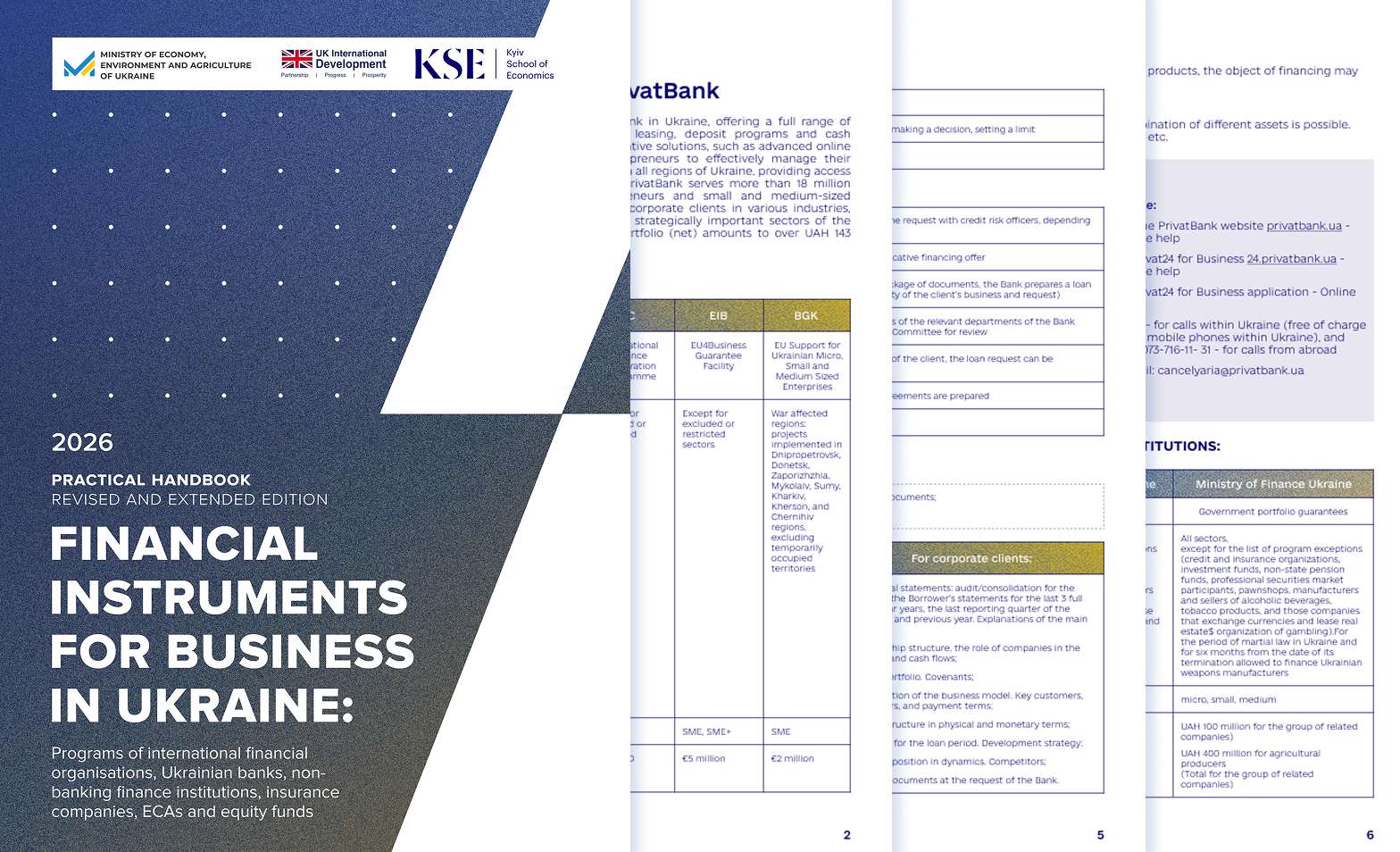
The Handbook “Financial Instruments for Business in Ukraine” systematises the ecosystem of financial instruments and explains how it works in practice. The Handbook compiles information on 65 financial institutions and their products – loans, guarantees, insurance, grants, leasing, factoring and investment instruments. For each product, the Handbook sets out the financing terms, business requirements, usage scenarios and contact details.
€20+billion
opportunities for businesses
13
types of instruments
65
financial institutions

Securing financing is a process that requires thorough preparation and positioning. Businesses should start by assessing their financial position, identifying their financial needs and preparing a high-quality project proposal.

The next step is to identify relevant financial partners (banks, IFIs, DFIs, export credit agencies) and launch targeted engagement with them.

Companies must also be prepared for the due diligence process, which covers financial, legal, operational and ESG aspects.

Transparency and proper preparation significantly increase the chances of securing funding.

1. Preparation

Refine financing purpose by analyzing financial statements and preparing a basic project profile.

2. Shortlisting options

Screen potential financiers (banks, DFIs, IFIs, ECAs) to narrow down realistic options and select the engagement format.

3. Initial engagement

Initiate outreach by sending a teaser/concept note, holding preliminary talks, and passing a “fit-to-mandate” check.

4. Due diligence

Prepare for due diligence by setting up a data room, updating the financial model, and engaging advisors for large projects.

5. Due diligence & Appraisal

Conduct due diligence by reviewing financial, technical, legal documents, completing ESG and risk assessment, and obtaining PRI/WRI, if needed.

6. Structuring & Approval

Agree financing terms by finalizing term sheets, obtaining internal approvals, and drafting key agreements.

7. Closing & Disbursement

Reach financial close by signing agreements, fulfilling conditions precedent, and completing disbursement set-up.

8. Implementation

Monitor implementation by reporting on financial and ESG aspects and updating financiers on project changes.
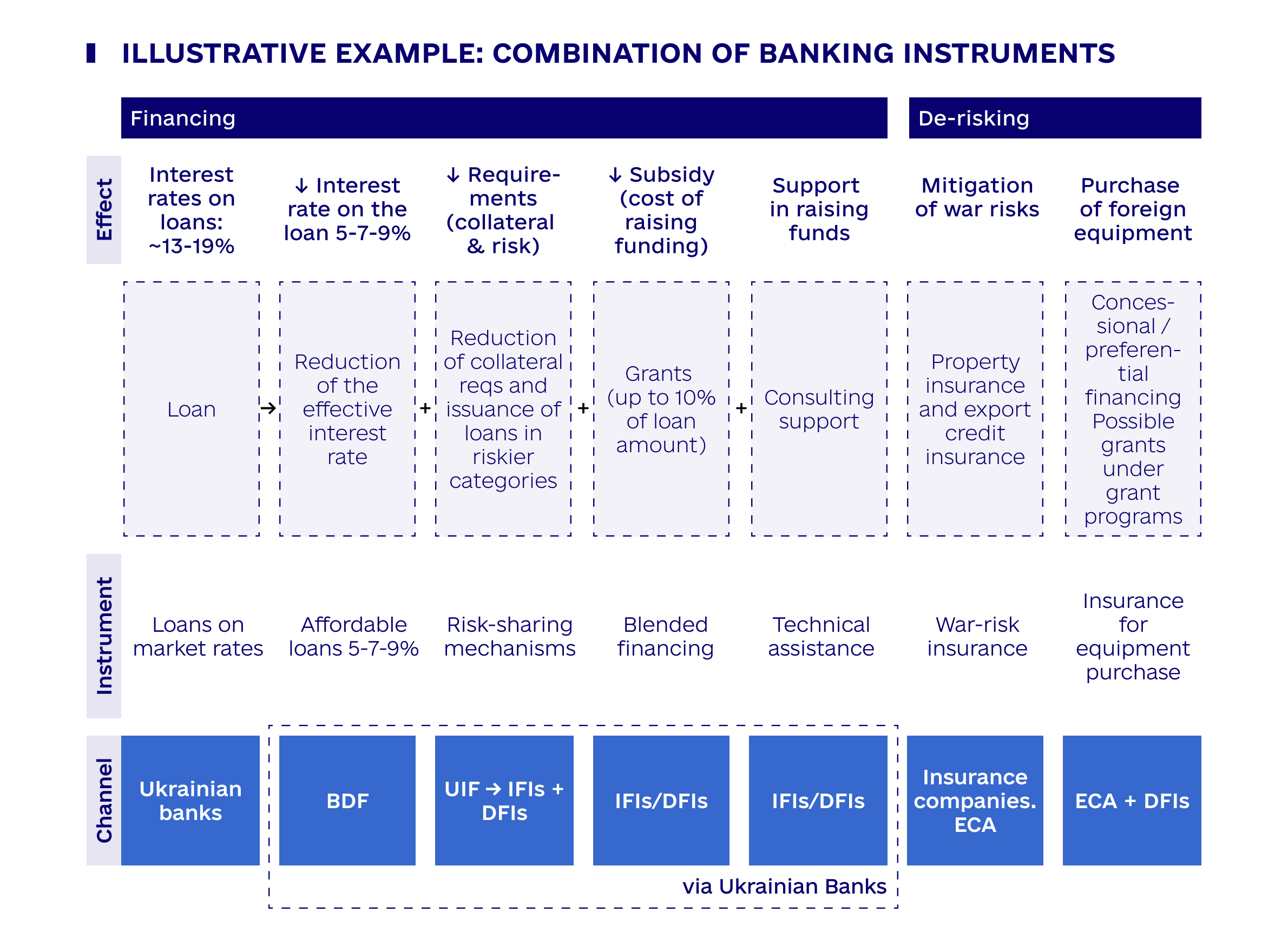
Ukraine’s financial system is rapidly transitioning to a hybrid model, where bank lending is complemented by government programmes, financing from IFIs/DFIs, guarantees and risk mitigation instruments. Alternative solutions – leasing and factoring – are expanding while the insurance toolkit is increasingly addressing prevalent risks in wartime conditions. Digitalisation and alignment with EU standards are increasing transparency and accessibility.

As a result, businesses can combine various instruments and sources to create more effective financial solutions and improve access to capital.

image-desktop image-mobile

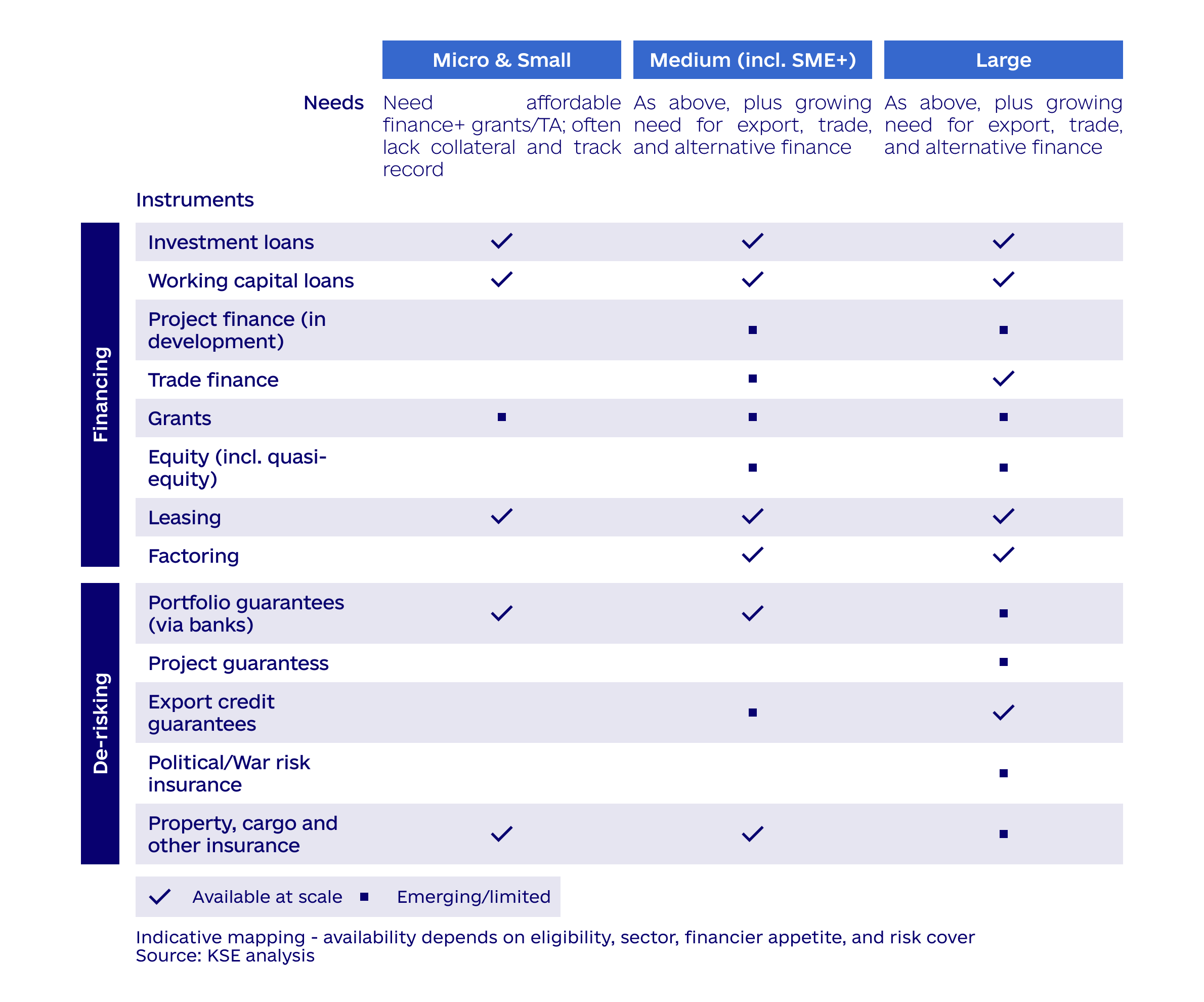
Ukrainian businesses have access to a wide range of financial and risk mitigation tools. However, their availability and suitability depend on the size of the company, its stage of development and specific needs. Micro and small enterprises, as well as medium and large businesses, face various constraints – ranging from a lack of collateral or credit history to more complex investment and risk management requirements.

Different instruments are more relevant for different types of business.

image-desktop image-mobile

This section presents the key financial instruments and funding opportunities available to businesses in Ukraine.

Investment loan

A medium- to long-term loan provided by banks or other financial institutions to finance capital expenditure, with a view to increasing capacity and long-term competitiveness. Investment loans are typically used for business expansion, acquisition or modernisation of equipment and facilities.

Project financing (under development)

This instrument is used to finance large investment projects, such as the construction of factories, infrastructure facilities or power generation units. Financing is based on the future cash flows of the project.

Working capital loan

A short- to medium-term loan designed to finance day-to-day operational needs. Working capital loans are typically used to cover expenses such as payroll, raw materials, inventory purchases, accounts payable, and other short-term liquidity requirements necessary to sustain business operations.

Trade finance

Short- to medium-term financial instruments that support domestic and international trade transactions. Common trade finance instruments include letters of credit, bank guarantees, documentary collections, and short-term trade loans. These tools are typically linked to specific contracts or shipments and are widely used by exporters and importers.

Blended finance

Instruments that combine commercial and concessional (non-repayable) financing to implement projects that have both economic and social or environmental benefits.

Grants

Irrevocable financial assistance provided by governments, international organisations, charitable foundations or institutions to support business, socially significant projects or innovative solutions. Grants do not require repayment of funds, which makes them particularly important for micro and small enterprises, as well as attractive for the development of new projects or the introduction of technologies.

Technical assistance

This often takes the form of consultancy and training services, which are provided in conjunction with the financing and help businesses improve their operations, introduce new technologies, develop human capital, and improve management or administrative processes.

Equity

Provides capital in exchange for an ownership stake in a company. For Ukrainian businesses, it is a key alternative to bank lending during the war, as it does not create fixed repayment obligations and enables long-term partnerships focused on growth and resilience.

Leasing

An asset-based financing instrument that allows businesses to acquire essential fixed assets, such as machinery, transport, or equipment, with minimal upfront payment. It is relevant for companies seeking investment financing, preserving liquidity, and avoiding additional collateral. Financial leasing typically transfers ownership at the end of the contract, whilst operating leasing offers flexible use and upgrade options.

Factoring

A financial instrument that converts receivables into immediate liquidity, accelerating cash flow and capital turnover. It is relevant for businesses, especially SMEs, working with deferred payment terms or large corporate/public-sector clients, providing an alternative to traditional bank loans and enhancing operational efficiency. Factoring also mitigates payment delay risks and strengthens financial stability.

Guarantees

A financial instrument that reduces the risks for the bank by providing compensation for part or all of the loan amount in the event of non-repayment. Guarantees can be provided by both government agencies and international financial organisations.

Export financing

Provides enterprises engaged in the export of goods or services with financial resources for the development of international trade. This can take the form of both export loans and export risk insurance.

Insurance

A risk-transfer instrument through which businesses pay a premium to cover potential losses, with providers compensating for defined risks; in Ukraine, traditional insurance is increasingly being complemented by emerging political and war-risk coverage mechanisms.

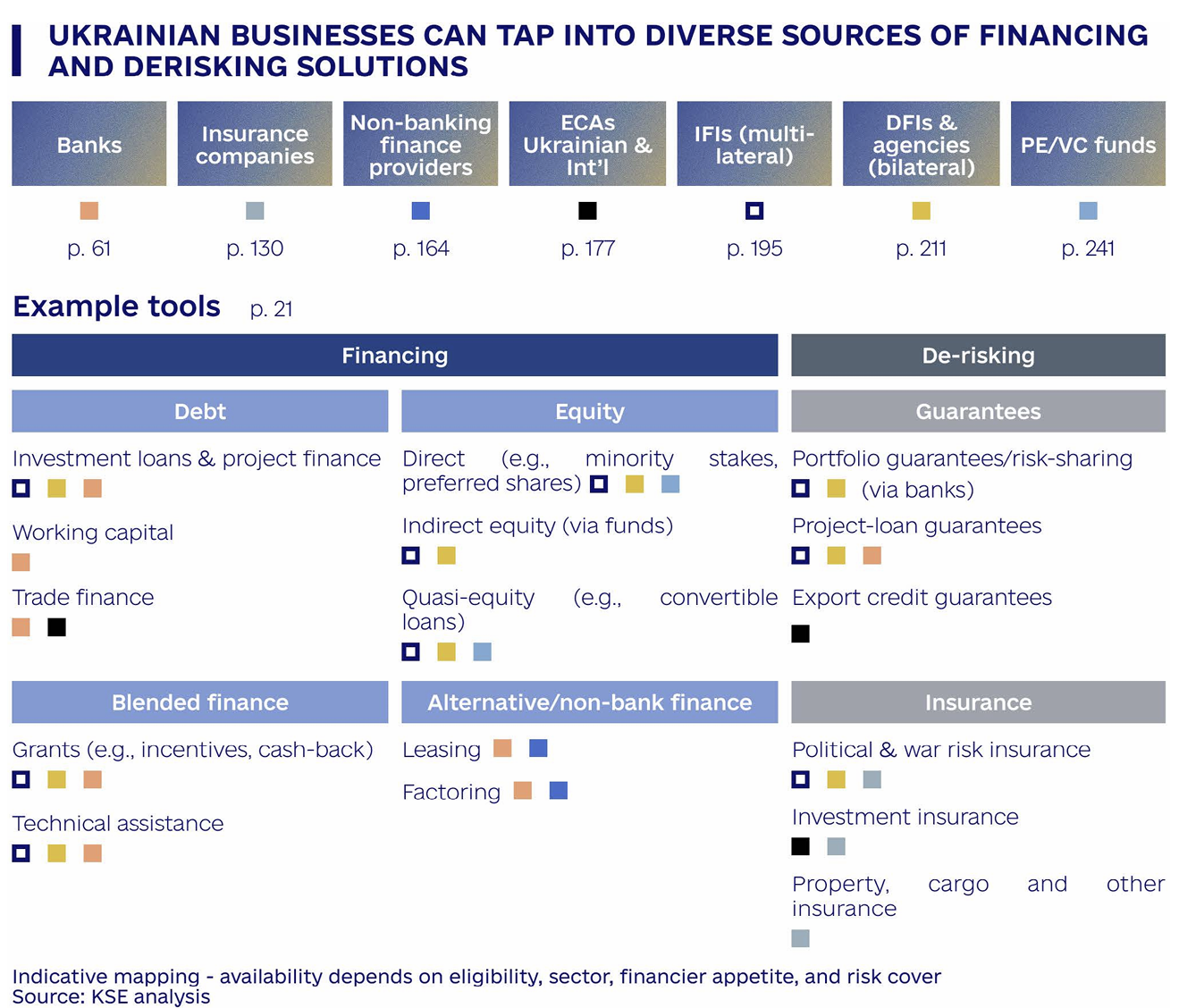
Access to finance depends not only on the size of the business or the type of instruments, but also on who provides them and how they work. Ukrainian companies can raise finance from banks, international financial institutions (IFIs), development finance institutions (DFIs), export credit agencies, investment funds and non-bank institutions. These partners offer a wide range of solutions – from loans, investments and blended finance to guarantees and insurance – which vary in terms of conditions, accessibility and scale.

Understanding these instruments and approaches helps businesses choose the right partners and effectively structure financing to suit their needs.

image-desktop image-mobile

Handbook presentation

The Handbook was launched at the conference “Financing Ukrainian Business: Needs, Instruments and Practical Solutions” held on 26 March 2026. The event was opened by Oleksiy Sobolev, Minister of Economy, Environment and Agriculture of Ukraine. Conference participants – representatives of Ukrainian business, the EBRD, IFC, EIB, Ukrainian banks, insurance and leasing companies – discussed how access to finance is changing and how instruments are adapting to business needs in 2026.

Handbook presentation
“Financial Instruments for Business in Ukraine” 2nd edition
Watch video
Speech by the Minister of Economy, Environment and Agriculture of Ukraine Oleksiy Sobolev
Watch video
Session I
"Business experience in raising financing"
Watch video
Session II
"The impact of the financial ecosystem"
Watch video

Please send your feedback, comments and suggestions regarding the 2nd edition of the Handbook “Financial Instruments for Business in Ukraine” and the available financial instruments and programmes to the KSE Institute email address

Property
Location
Project initiator
Total budget in USD, mln
Required financing in USD, mln
Project's Highlights
Type of financing
Financing structure
Project implementation stage
Year the project started
Project launch period, years
Expected Financial Indicators
NPV, $ mln
IRR, %
DPP, years
Revenue (per year), $ mln
EBITDA (per year), $ mln